
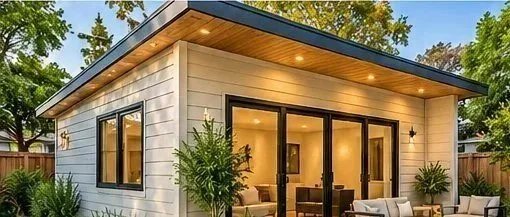
Building an Accessory Dwelling Unit (ADU) is one of the most effective ways California homeowners can add flexible living space, create rental income, accommodate family, and potentially increase property value.
One of the first major decisions is whether to build a modular ADU—constructed primarily in a factory and transported to the site—or a traditional stick-built ADU, assembled onsite using conventional building methods.
Modular ADUs are often advertised as faster and less expensive. Those benefits can be real, but transportation, cranes, foundations, utilities, permitting, and site limitations can change the equation. Stick-built ADUs offer more design freedom and adaptability, but usually require more onsite construction time.
Neither approach is universally better. This guide explains the practical tradeoffs and why comparing fully completed project costs matters.
In This Guide
Understanding the Difference
Cost: Which Construction Method Is Less Expensive?
Construction Timeline: Is Modular Really Faster?
Design Flexibility and Customization
Site Access: An Overlooked Consideration
Permitting and Building-Code Compliance in California
Construction Quality and Durability
Foundations, Utilities, and Site Preparation
Homeowner Disruption and Neighborhood Impacts
Changes During Construction
Financing, Appraisals, Insurance, and Resale Value
Environmental Sustainability and Energy Efficiency
Warranties, Repairs, and Long-Term Maintenance
Comparison: Modular vs. Stick-Built ADUs
Which Construction Method Is Best for Your Property?
Questions to Ask Before Choosing Modular Construction
The Importance of a Professional Feasibility Study
Final Conclusion: Which Is the Better Choice?
1. Understanding the Difference
What is a modular ADU?
A modular ADU is built primarily in a factory, either as a complete dwelling or as large sections, then transported to the property, installed on a foundation, and connected to utilities. Factory work may include cabinetry, plumbing, electrical systems, insulation, and finishes. California factory-built housing generally follows a state-supervised approval process.
What is a traditional stick-built ADU?
A stick-built ADU is constructed primarily onsite. Contractors prepare the site, build the foundation, frame the structure, and install roofing, windows, utilities, insulation, and finishes. The design can be tailored to the property and the homeowner.
Not all prefabricated buildings are the same
Modular housing, panelized construction, and HUD-code manufactured housing are different approaches. Panelized systems use factory-made walls or other assemblies installed onsite; manufactured housing follows a separate federal regulatory framework. Homeowners should verify which system is being offered because codes, financing, and installation requirements may differ.
2. Cost: Which Construction Method Is Less Expensive?
Potential modular savings
Factory production can lower manufacturing costs through bulk material purchasing, standardized floor plans, repetitive labor, reduced waste, and less weather disruption. These advantages are meaningful, but the factory price is not the finished-project price.
Modular costs that may be excluded
Ask about freight, oversized-load permits, escorts, crane rental, temporary street closures, staging, foundations, site preparation, engineering, permitting, utility trenches, electrical upgrades, sewer connections, module joining, and final inspections. Access challenges can eliminate apparent factory savings.
Stick-built cost tradeoffs
Traditional construction usually avoids transporting a completed building and using a large installation crane. Local contractors can adapt materials and methods to a difficult lot. However, labor rates, subcontractor availability, weather, changes, and delays can increase costs.
Compare turnkey proposals
The meaningful comparison is the total price for a permitted, installed, inspected, finished, move-in-ready ADU. Compare identical scopes and allowances. A low modular sticker price can ultimately exceed a comparable stick-built quote, while an accessible flat site with a standard plan can favor modular construction.
3. Construction Timeline: Is Modular Really Faster?
Factory and site work can overlap
Modular production can proceed while a contractor prepares the foundation and utilities, shortening onsite construction. Delivery and placement may take relatively little time once the site is ready.
The whole project still takes time
Design selection, factory production queues, site-specific engineering, permit approvals, foundation construction, transport scheduling, utility connections, onsite finish work, and final inspections all affect completion. A delivered module is not automatically ready for occupancy.
Traditional sequencing
Stick-built construction requires more sequential onsite work and is more exposed to weather and subcontractor scheduling. It can, however, offer greater flexibility to adjust work sequences and coordinate deliveries.
Bottom line
Request schedules from contract signing to final occupancy approval, not simply advertised factory construction durations.
4. Design Flexibility and Customization
Modular limitations
Many manufacturers offer a defined set of floor plans, exterior styles, and finish packages. Major changes to dimensions, roof shape, structural layout, or window locations may be costly or unavailable. Transport limits can constrain building width and configuration.
Stick-built advantages
An architect can optimize the design for setbacks, trees, views, privacy, outdoor space, architectural compatibility, accessibility, and irregular property lines. Custom two-story or above-garage solutions are often easier to develop onsite.
When standardization helps
If an existing modular floor plan suits the property and homeowner, limiting customization can save design time and improve budget predictability.
5. Site Access: An Overlooked Consideration
The modular delivery challenge
Large modules must travel along roads, navigate turns, and reach a crane or installation location. Overhead wires, trees, narrow streets, parked cars, nearby buildings, and steep grades can cause substantial complications. Some backyard installations require lifting the structure over the primary residence.
Stick-built access advantages
Lumber, drywall, fixtures, and other materials can usually arrive in smaller loads and pass through narrower access routes. Traditional construction still has excavation and concrete-delivery challenges, but it rarely needs an entire building transported over the property.
Bottom line
Obtain a site-specific transportation and crane feasibility assessment before ordering a modular ADU.
6. Permitting and Building-Code Compliance in California
Factory approval is not local site approval
California HCD oversees its Factory-Built Housing program, including approved design and factory inspection pathways. Local authorities still review applicable site-specific work, installation, foundations, setbacks, utilities, drainage, and fire-related conditions.
A frequent misunderstanding
A state-approved modular design does not mean it is automatically approved for placement on a particular parcel. Site-specific engineering and local permits may still be required.
San Diego considerations
City of San Diego Information Bulletin 241 addresses factory-built housing permitting. Owners should confirm current local requirements with the applicable jurisdiction before signing a manufacturing agreement. Traditional stick-built projects follow conventional local plan review and phased onsite inspections.
7. Construction Quality and Durability
Modular strengths
A controlled factory environment protects materials from weather, allows repeatable production processes, and may improve consistency. Some modules incorporate structural reinforcement to withstand transport and lifting.
Modular risks
Module joints, waterproofing, transportation damage, lifting stresses, and onsite connections require careful detailing and inspection. Clarify who repairs damage discovered after delivery.
Stick-built strengths and risks
Onsite construction allows local adaptation and inspections during construction, but workmanship varies by contractor, and materials can be exposed to weather. Neither method guarantees superior durability: good design, materials, supervision, and installation matter most.
8. Foundations, Utilities, and Site Preparation
Foundations
Both methods need properly engineered foundations. Modular units may require particularly precise bearing locations, anchor positions, and utility penetrations to match factory construction.
Utilities
Water, sewer, electrical service, trenches, drainage, and possible panel or service upgrades can be major costs for either method. Utility distances and existing capacity can outweigh differences in construction technique.
Site work
Both approaches may require demolition, grading, retaining walls, tree work, soil engineering, and drainage improvements. Modular installation can additionally require crane staging and access for oversized equipment.
9. Homeowner Disruption and Neighborhood Impacts
Modular
Less time may be spent building onsite, reducing prolonged dust, noise, and worker traffic. The delivery day can nonetheless involve large trucks, cranes, road restrictions, and concentrated neighborhood disruption.
Stick-built
Onsite work generally lasts longer, with more frequent deliveries and tradespeople. Smaller deliveries and phased construction can be easier to coordinate around an occupied residence.
10. Changes During Construction
Modular
Selections often must be finalized before factory production. After manufacturing begins, moving windows, changing layouts, or revising systems may be costly or impractical.
Stick-built
Onsite construction typically allows more opportunities for changes before affected work is completed, although changes may still trigger added cost, revised engineering, and permit updates.
Bottom line
Finalize major design decisions early with either method to minimize change orders.
11. Financing, Appraisals, Insurance, and Resale Value
Financing modular construction
Manufacturers may require substantial deposits or factory-stage payments before delivery. Confirm that a construction lender will finance those milestones and determine when ownership of the module transfers.
Financing stick-built construction
Traditional projects often fit established lender progress-draw practices tied to onsite completion, but lender policies vary.
Value and appraisal
A legally permitted, permanently installed modular ADU can contribute value comparable to a stick-built ADU. Appraisal depends on local comparables, quality, legal status, and market demand; there is no universal discount for modular housing.
Insurance
Clarify who insures the building during factory production, transit, crane placement, and installation. For either method, verify construction insurance and completed-property coverage.
12. Environmental Sustainability and Energy Efficiency
Modular advantages
Standardized cutting and inventory can reduce material waste; factory conditions may improve insulation and air-sealing consistency.
Modular disadvantages
Long-distance transport, oversized trucks, lifting equipment, and packaging can offset some manufacturing efficiencies.
Stick-built possibilities
Local material sourcing and site-specific passive solar design, shading, and ventilation can reduce environmental impact.
Energy code
Both approaches must satisfy applicable California energy-efficiency standards. Long-term performance depends on design, air sealing, insulation, systems, and execution more than construction location.
13. Warranties, Repairs, and Long-Term Maintenance
Modular responsibility can be fragmented
A manufacturer, carrier, crane contractor, foundation contractor, and installation contractor may all be involved. A leak at a module joint can create disputes about whether the factory or installer is responsible.
Traditional accountability
One general contractor may coordinate subcontractor warranty service, potentially simplifying communication, though service quality varies.
Questions to resolve
Get written warranty terms, responsibility for diagnosis and repair, transportation-damage procedures, response times, and replacement-part availability.
14. Comparison: Modular vs. Stick-Built ADUs
Advertised price: Modular ADU: Often lower; Stick-built ADU: Often higher
Finished cost: Modular ADU: Site-dependent; Stick-built ADU: Site-dependent
Onsite timeline: Modular ADU: Potentially shorter; Stick-built ADU: Usually longer
Design flexibility: Modular ADU: More limited; Stick-built ADU: Highly flexible
Narrow lots: Modular ADU: Often difficult; Stick-built ADU: Usually adaptable
Permitting: Modular ADU: Factory/state + local; Stick-built ADU: Local review
Weather exposure: Modular ADU: Less in factory; Stick-built ADU: More onsite
Crane/transport: Modular ADU: Often significant; Stick-built ADU: Typically not needed
Changes mid-build: Modular ADU: More difficult; Stick-built ADU: More flexible
Utilities/foundation: Modular ADU: Required; Stick-built ADU: Required
Warranty: Modular ADU: Multiple parties possible; Stick-built ADU: Often GC coordinated
Long-term value: Modular ADU: Can be comparable; Stick-built ADU: Can be comparable
15. Which Construction Method Is Best for Your Property?
Flat, accessible backyard
Modular construction may be competitive where streets are accessible, utilities are nearby, crane setup is straightforward, and a standard plan fits.
Narrow urban lot
Stick-built is often more practical where access is constrained by houses, fences, trees, overhead wires, or unusual lot dimensions.
Two-story or above-garage ADU
Stick-built often provides more structural and design flexibility, although specialized modular solutions may be possible.
Simple rental ADU
A standardized modular unit may be a strong option when speed and a straightforward layout matter more than customization.
16. Questions to Ask Before Choosing Modular Construction
Pricing and scope
Does the quote include delivery, crane, foundation, permits, utilities, inspections, and site restoration? What is excluded?
Feasibility
Has a qualified professional confirmed truck access, crane feasibility, setbacks, and installation requirements?
Approvals and engineering
Who prepares site-specific plans, obtains local permits, and responds to agency comments? What factory approvals are supplied?
Scheduling and financing
What are realistic production, delivery, and completion dates? What deposits are required and how are payments protected?
Risk and warranties
Who carries insurance during factory production, transport, and lifting? Who repairs damage and handles warranty disputes?
Before signing, ask for a written turnkey scope, proof of site access and crane feasibility, responsibility for permitting, payment protections, insurance during transportation, and warranty coverage.
17. The Importance of a Professional Feasibility Study
Evaluate the property before choosing a product
A professional feasibility review should address parcel dimensions, setbacks, building placement, topography, existing improvements, utilities, access, drainage, and applicable development rules.
Compare construction methods on the same basis
For modular, confirm transport and crane installation; for stick-built, evaluate access, construction staging, and site-specific design. Develop realistic turnkey budgets before committing to either method.
Why it matters
Early investigation can reveal hidden expenses and avoid redesigns, contract changes, and preventable delays.
18. Final Conclusion: Which Is the Better Choice?
The key tradeoff
Modular ADUs can offer factory efficiencies, reduced weather exposure, and less onsite construction. These advantages must be weighed against transportation, crane installation, access limits, design constraints, and coordination among multiple providers.
Where stick-built shines
Traditional construction often offers greater flexibility for unusual lots, architectural integration, narrow access, and custom configurations. Its tradeoffs include longer onsite activity and more exposure to local labor and weather conditions.
The central lesson
The least expensive ADU to manufacture is not necessarily the least expensive ADU to complete. Compare fully permitted, installed, inspected, and finished projects. The right method depends on the property, design, and total project cost.
Planning an ADU in California?
ADU Pros can help you assess your property and understand your options before committing to a construction method.