
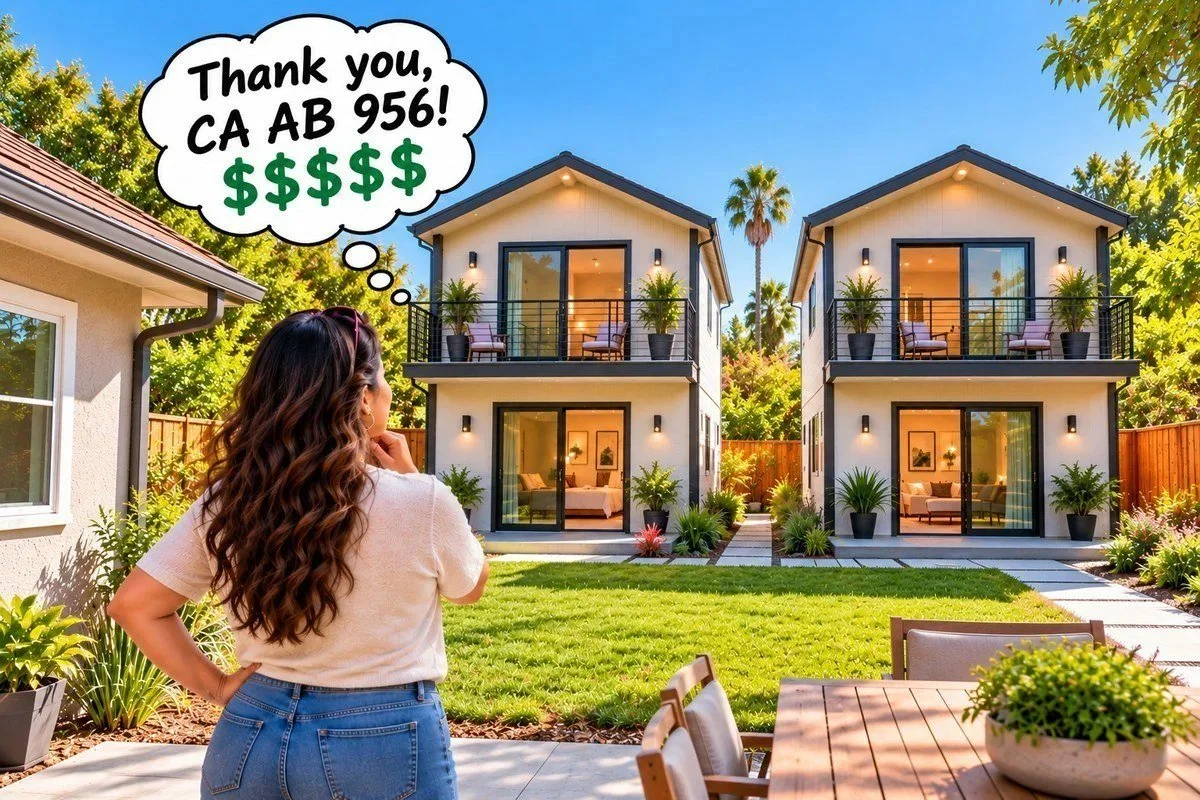
For years, California has steadily expanded the rights of homeowners to build Accessory Dwelling Units (ADUs). Now, a newly signed state law takes another major step forward.
Thinking about an ADU? Tell us about your project and we’ll contact you →
Governor Gavin Newsom has signed Assembly Bill 956 (AB 956), legislation that expands California's state-mandated ADU provisions and could dramatically increase the development potential of many single-family residential properties. AB 956 takes effect January 1, 2027.
The Big Change: From One Detached ADU to Two
Under the previous state-law provision, a property with an existing or proposed single-family home could qualify for ministerial approval of one detached, new-construction ADU under specific state standards.
AB 956 changes that number from one to two.
The new language requires local agencies to ministerially approve two detached, new-construction ADUs on a lot with a proposed or existing single-family dwelling when the project meets the applicable requirements.
That seemingly small change could have a very big impact.
Instead of a property containing:
Main House + 1 Detached ADU
a qualifying property could potentially contain:
Main House + ADU #1 + ADU #2
For homeowners with sufficient space, that creates an entirely new range of possibilities.
How Large Can the Two ADUs Be?
Under this particular state-law pathway, a local agency may limit each detached ADU to 800 square feet of livable space. But that doesn't necessarily mean 800 square feet is the largest ADU you can build.
Many California municipalities have ADU regulations that allow larger ADUs, depending on the jurisdiction and the specific property.
So, before assuming your two ADUs must be limited to 800 square feet each, it's important to understand both California law and your municipality's local ADU regulations. Depending on where your property is located, you may have options that go beyond the state minimum.
Can You Build Two ADUs AND a JADU?
This is an important limitation.
AB 956 expressly provides that a local agency is not required to allow two detached ADUs plus a Junior Accessory Dwelling Unit (JADU) on the same property. It also states that a local agency is not required to ministerially approve a JADU on a property where the two detached new-construction ADUs have been constructed under this provision.
That makes proper planning even more important.
Depending upon the property and the owner's goals, the best development strategy may involve two detached ADUs, an ADU/JADU configuration, or another configuration available under California and local law.
Another Important Change: More Protection From HOA Restrictions
AB 956 isn't limited to the two-ADU provision.
The legislation also expands protections against private covenants and restrictions that effectively prohibit or unreasonably restrict qualifying ADUs and JADUs.
The revised language applies these protections to property “zoned to allow single-family residential use,” rather than simply property “zoned for single-family residential use.” The legislation also revises protections involving common-interest developments.
This distinction may be important for properties located in zoning districts that allow single-family homes but are not exclusively single-family residential zones.
Reasonable restrictions can still be imposed, but they cannot unreasonably increase construction costs, effectively prohibit construction, or eliminate the ability to construct an otherwise qualifying ADU or JADU.
Does This Mean Every California Homeowner Can Build Two ADUs?
In many cases, but it is not guaranteed. AB 956 creates a powerful state-law approval pathway, but every property still needs to be evaluated individually.
Lot configuration, existing structures, easements, utility locations, sewer or septic capacity, fire requirements, building-code requirements, coastal restrictions and other site conditions can affect what can actually be constructed.
There can also be important differences between what state law requires a city to approve and what a particular city may voluntarily allow beyond the state's minimum requirements.
That is why the first step shouldn't necessarily be deciding what to build. The first step should be determining everything your property is legally and physically capable of supporting.
The Right ADU Professional Can Make All the Difference
California's ADU laws have become increasingly powerful—but they have also become increasingly complex.
Determining the best development strategy for a property isn't simply a matter of reading one section of state law. An experienced ADU professional needs to understand how state ADU law, local municipal regulations, zoning, building and fire codes, utilities, easements and the physical characteristics of the property all work together.
At ADU Pros, ADUs aren't an occasional side project—they are our specialty.
We help homeowners evaluate the full development potential of their property and then guide the project through feasibility, design, permitting and construction. Our goal isn't simply to determine whether you can build an ADU. It's to help determine the best ADU project your property can support.
With AB 956 opening the door to two detached ADUs on qualifying single-family properties, having the right strategy from the beginning may be more valuable than ever.
Could your property accommodate two ADUs—or perhaps more ADU square footage than you realize?
Contact ADU Pros for a property evaluation. We'll help you understand the state and local rules that apply to your property, evaluate your options, and develop a plan designed around your property and your goals.