
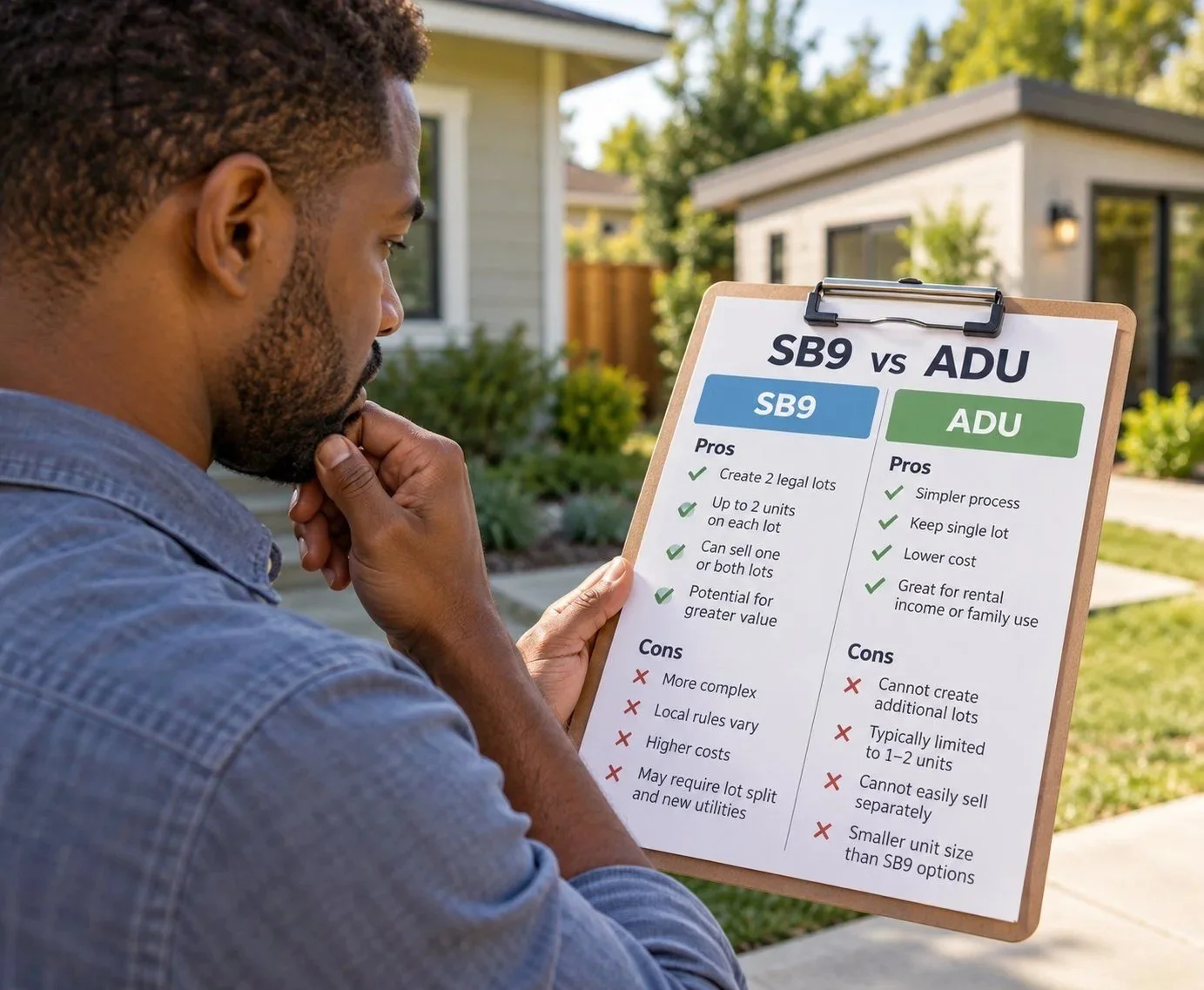
California's ADU laws provide an excellent way to add housing to an existing property. However, for the right property, SB 9 can unlock development opportunities that an ADU cannot.
The biggest advantages are the ability to build primary residences that may be larger than an ADU, potentially divide one property into two legal lots, and take advantage of a ministerial approval process with powerful protections against local development standards that would otherwise prevent the project.
1. SB 9 Units Are Primary Dwellings—and May Be Larger Than ADUs
One of the most important differences between an ADU and an SB 9 unit is that an SB 9 unit can be a primary dwelling, rather than an accessory dwelling.
Many California municipalities limit ADUs to a maximum of 1,200 square feet. Some jurisdictions allow larger ADUs, so 1,200 square feet should not be considered a universal statewide maximum.
SB 9 primary units are different. They are not subject to an ADU's local maximum size simply because they were created under SB 9. Their allowable size depends on the objective zoning and development standards applicable to the property.
Many municipalities therefore allow SB 9 primary residences to be larger than 1,200 square feet.
This can be a major advantage for a property owner who has enough land to build a substantial second residence rather than a smaller accessory dwelling.
In some cases, the difference between building a 1,200-square-foot ADU and a substantially larger primary residence can dramatically change the development and resale potential of the property.
2. SB 9 Can Turn One Property Into Two Legal Lots
The urban lot split is potentially the most powerful feature of SB 9.
A qualifying property can potentially be divided into two separate legal parcels, and SB 9 requires qualifying projects to be able to accommodate up to two units on each resulting parcel, subject to the requirements of the law.
Conceptually, one property can become:
LOT A
Existing or New Primary Residence
Potential Second Unit
LOT B
New Primary Residence
Potential Second Unit
That can create development potential for as many as four residential units across two legal parcels. More importantly, the owner has potentially transformed one piece of real estate into two separately transferable properties.
This creates several possible exit strategies. An owner could potentially:
Keep both properties as long-term investments.
Keep the existing house and sell the newly created parcel.
Sell the original property and retain the new parcel.
Develop the new parcel and sell the completed home.
Develop both parcels and potentially sell them separately.
Hold multiple units as rental properties and sell one or both parcels in the future.
This is fundamentally different from an ADU project. With a conventional ADU, the owner generally still has one property containing multiple dwellings. With an SB 9 lot split, the owner can potentially create two separate pieces of real estate.
3. SB 9's Ministerial Process Can Unlock Otherwise Undevelopable Land
This is one of SB 9's most important—and sometimes misunderstood—advantages. An SB 9 urban lot split is a ministerial process for a qualifying property. This means the city reviews the project against objective requirements rather than deciding through a discretionary planning process whether the subdivision is desirable.
There is generally no Planning Commission or City Council hearing deciding the merits of the qualifying SB 9 project. Even more importantly, SB 9 places significant limitations on local zoning and subdivision standards that would prevent the development authorized by the law.
For example, conventional subdivision rules might otherwise require:
Minimum lot sizes • Minimum lot widths or depths • Larger side and rear setbacks • Lot coverage limitations • Floor-area limitations • Other subdivision or development standards
SB 9 can prevent these objective standards from being applied when they would physically preclude the qualifying lot split or the construction of the housing that SB 9 requires the jurisdiction to allow.
State law generally requires an SB 9 urban lot split to create two parcels of roughly comparable size, with neither parcel smaller than 40% of the original parcel, and generally requires each resulting parcel to contain at least 1,200 square feet. Local jurisdictions cannot simply impose their normal, larger minimum lot size if doing so would prevent a qualifying SB 9 split.
Similarly, local objective zoning, subdivision, and design standards cannot be applied in a way that physically prevents the construction of up to two qualifying units of at least 800 square feet each on a resulting parcel.
SB 9 also generally limits required side and rear setbacks for new construction to four feet, subject to the statute's rules and exceptions. These protections are extremely important because the resulting SB 9 parcels may be much smaller than lots that could ordinarily be created under the municipality's subdivision ordinance.
In practical terms, SB 9 can turn a portion of a property that could not ordinarily become a legal building lot into a separately developable residential parcel. That ability to unlock the underlying land is one of the primary reasons SB 9 can be so valuable.
SB 9 Does Not Eliminate Engineering or Construction Requirements
SB 9's development protections are powerful, but they should not be confused with an exemption from the technical requirements involved in subdividing and developing real estate.
An SB 9 lot split may still require substantial professional work involving:
Land surveying • Civil engineering • Parcel mapping • Legal descriptions • Sewer design • Water service • Electrical service • Drainage • Grading • Utility easements • Access • Fire requirements • Building and structural engineering
The project must also comply with applicable building, structural, fire, health and safety requirements. These items can become expensive—particularly when the proposed new parcel has difficult access, drainage, sewer, utility, grading, or existing-building conditions. For this reason, not every property that qualifies for an SB 9 lot split should necessarily be split.
The Key Question: How Much Land Value Does the Lot Split Unlock?
The real value of an SB 9 lot split should be evaluated as a real-estate development decision.
The question is not simply: "Can this property be split?"
The better question is: "Does splitting this property create enough additional land and development value to justify the cost, time, and complexity of doing it?"
For example, imagine an existing property where an SB 9 split creates a second legal parcel capable of supporting a desirable new primary residence. That new parcel may have significant value as: A buildable lot, a completed home, a rental property, or a separately saleable real-estate asset.
If the value created by that new parcel substantially exceeds the surveying, engineering, entitlement, utility, design, financing, and construction-related costs necessary to create it, the SB 9 lot split may represent a compelling development opportunity.
If substantial retaining walls, sewer extensions, utility relocations, access improvements, grading, or other engineering work are required, the economics can look very different.
That is why SB 9 feasibility should be evaluated before significant design and engineering money is spent.
The Bottom Line
An ADU is often an excellent solution when the objective is simply to add another residence to an existing property. SB 9 becomes especially interesting when the property has underutilized land with the potential to become a valuable residential asset.
The three major opportunities are:
Larger Primary Residences: Many municipalities allow SB 9 primary dwellings to exceed the 1,200-square-foot maximum commonly applied to ADUs.
Two Legal Parcels: A qualifying SB 9 lot split can potentially transform one property into two legal lots, with up to two units on each resulting parcel and the ability to potentially sell, retain, or develop the parcels separately.
Powerful State-Law Development Protections: SB 9 requires ministerial processing and limits the ability of local minimum lot-size, setback, subdivision, and other objective development standards to prevent the housing and lot split that state law requires a jurisdiction to allow. These advantages can make SB 9 much more than a way to add another dwelling.
For the right property, SB 9 can unlock the value of land that could not otherwise be subdivided or developed in the same way.
However, creating a new legal parcel involves real surveying, civil engineering, utility, mapping, and construction requirements. Those costs can be substantial.
The goal of an SB 9 feasibility study should therefore be to determine not only whether the property can be split, but whether the value unlocked by creating the new parcel justifies the time and money required to create it.