
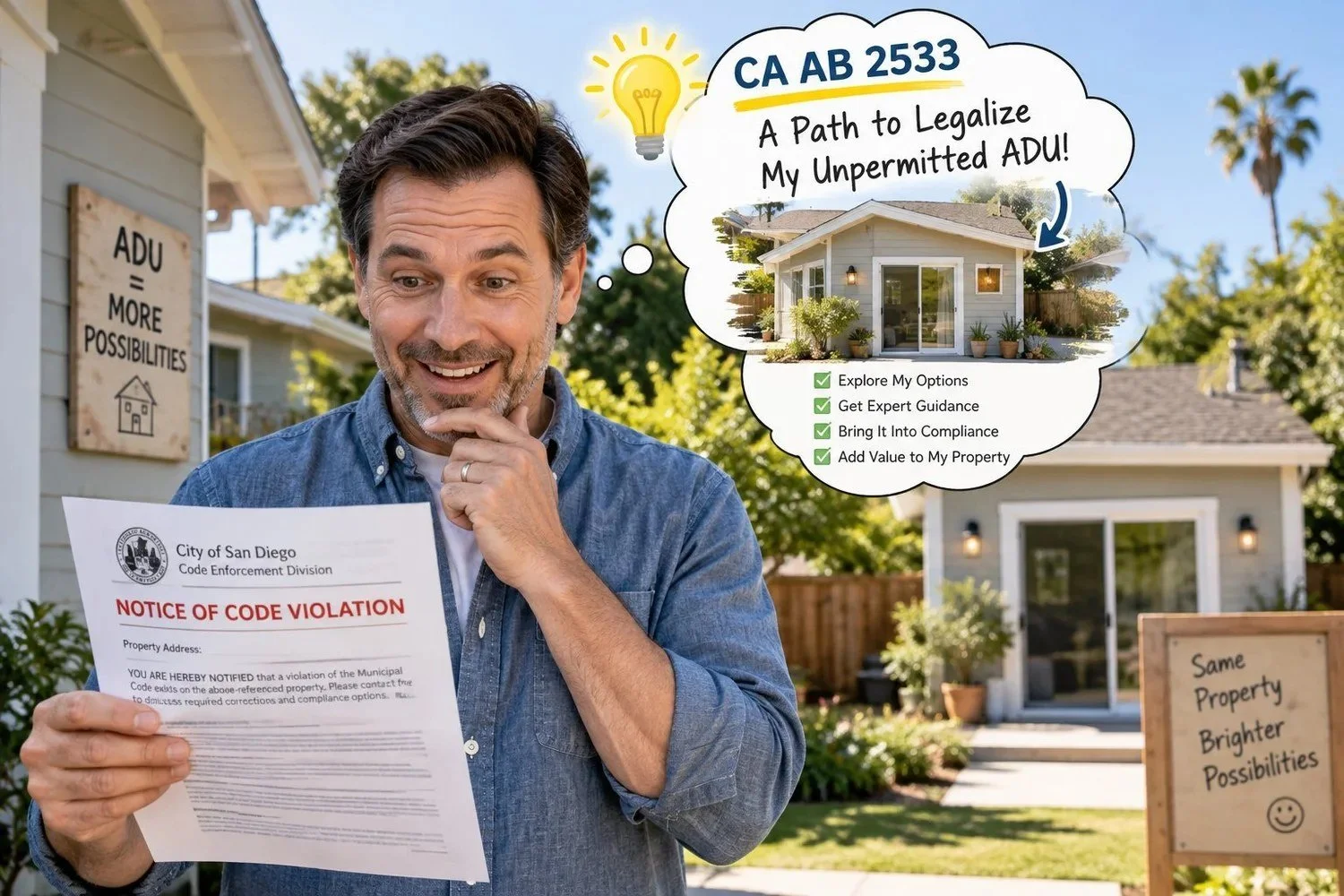
California homeowners with an unpermitted ADU, garage conversion, granny flat, or Junior ADU may have a significant opportunity to bring that space into compliance.
California AB 2533 created important protections for homeowners seeking to legalize qualifying ADUs and JADUs constructed before January 1, 2020.
For years, many property owners have been reluctant to approach their city or county about an older, unpermitted unit. They may be concerned that the structure doesn't meet today's zoning requirements, setbacks, building standards, or other regulations—or that simply applying for a permit could expose them to penalties or expensive fees.
AB 2533 was designed to address many of those concerns and create a clearer path toward legalization.
What AB 2533 Can Mean for Homeowners
1. An older ADU may not have to meet every current ADU requirement.
For qualifying ADUs and JADUs constructed before January 1, 2020, a local agency generally cannot deny a permit simply because the existing unit violates building standards or does not comply with current state or local ADU regulations.
There is an important exception: health and safety conditions that would cause the building to be considered "substandard" may still need to be corrected.
In practical terms, this can make legalization much more realistic for older units that were constructed without permits or that don't perfectly match today's development standards.
2. The process focuses heavily on health and safety.
AB 2533 does not mean that every existing structure automatically becomes legal. The local jurisdiction may inspect the unit for compliance with health and safety standards and identify corrections necessary to obtain a permit. This can include issues involving electrical, plumbing, structural conditions, fire and life safety, sanitation, weather protection, or other conditions covered by California's substandard-building requirements. The important distinction is that an older unit isn't necessarily disqualified simply because it was originally built without permits or fails to satisfy every standard that might apply to a brand-new ADU.
3. Homeowners receive important protection from penalties during the legalization process.
When a homeowner applies to legalize a qualifying pre-2020 ADU or JADU, AB 2533 provides that the local agency cannot penalize the applicant simply for having the unpermitted unit. If an inspection identifies health and safety deficiencies, the jurisdiction must allow the necessary permits to be obtained to correct those deficiencies. For homeowners who have avoided legalization because they were worried about what might happen once the city discovered the unit, this can substantially change the conversation.
4. Certain fees may be eliminated.
Another potentially significant benefit is financial. For qualifying pre-2020 unpermitted ADUs and JADUs, homeowners generally cannot be required to pay impact fees or utility connection or capacity charges as part of legalization, except in specified circumstances involving utility infrastructure required to address substandard conditions. Depending on the property and jurisdiction, avoiding these charges can potentially reduce the cost of legalization.
5. You can investigate the condition of the unit before applying.
AB 2533 specifically requires jurisdictions to inform homeowners that they may obtain a confidential third-party code inspection from a licensed contractor before submitting the permit application. This gives homeowners an opportunity to better understand the existing condition of the unit and the potential scope of improvements before beginning the formal permitting process.
That can make it much easier to answer the questions homeowners care about most:
Can my ADU be legalized?
What improvements will I need to make?
How much could the work cost?
What plans, inspections, and permits will be required?
Why Legalize an Existing ADU?
An unpermitted unit can create uncertainty when refinancing, selling, remodeling, obtaining insurance, dealing with code enforcement, or documenting the permitted characteristics of a property. Legalization can provide a clearer record of the improvements on the property and, when the unit successfully completes the applicable permitting and inspection process, establish the space as a legally recognized ADU or JADU. For some homeowners, an existing garage conversion, backyard unit, guest house, or converted portion of a home may have been built many years ago. AB 2533 may provide an opportunity to finally address its permit status rather than continuing to live with that uncertainty.
The Unit Does Not Have to Be Perfect to Start the Conversation
This is perhaps the most important thing for homeowners to understand.
An existing unpermitted ADU should not automatically be assumed to be impossible to legalize simply because it does not comply with today's rules.
AB 2533 specifically created protections for qualifying older ADUs and JADUs.
There may still be substantial work required. Every property is different, and structural, electrical, plumbing, fire-safety, zoning, utility, and other conditions must be evaluated individually. But a unit that might previously have seemed extremely difficult to permit may now have a much clearer path toward legalization.
Do You Have an Unpermitted ADU?
If you have an older:
Garage conversion
Backyard cottage
Granny flat
Guest house
Converted basement
Converted portion of your home
Junior ADU
Or other space being used as a separate dwelling
…and you believe it was constructed before January 1, 2020, now may be a good time to investigate your options.
We can help evaluate your property, determine the likely path toward legalization, identify potential issues, prepare the required plans, and help navigate the permitting process.
Don't assume that an older unpermitted unit can't be legalized.
This information is provided for general informational purposes and is not legal advice. Eligibility and required corrections depend on the specific property, existing conditions, applicable codes, and the local permitting agency.