
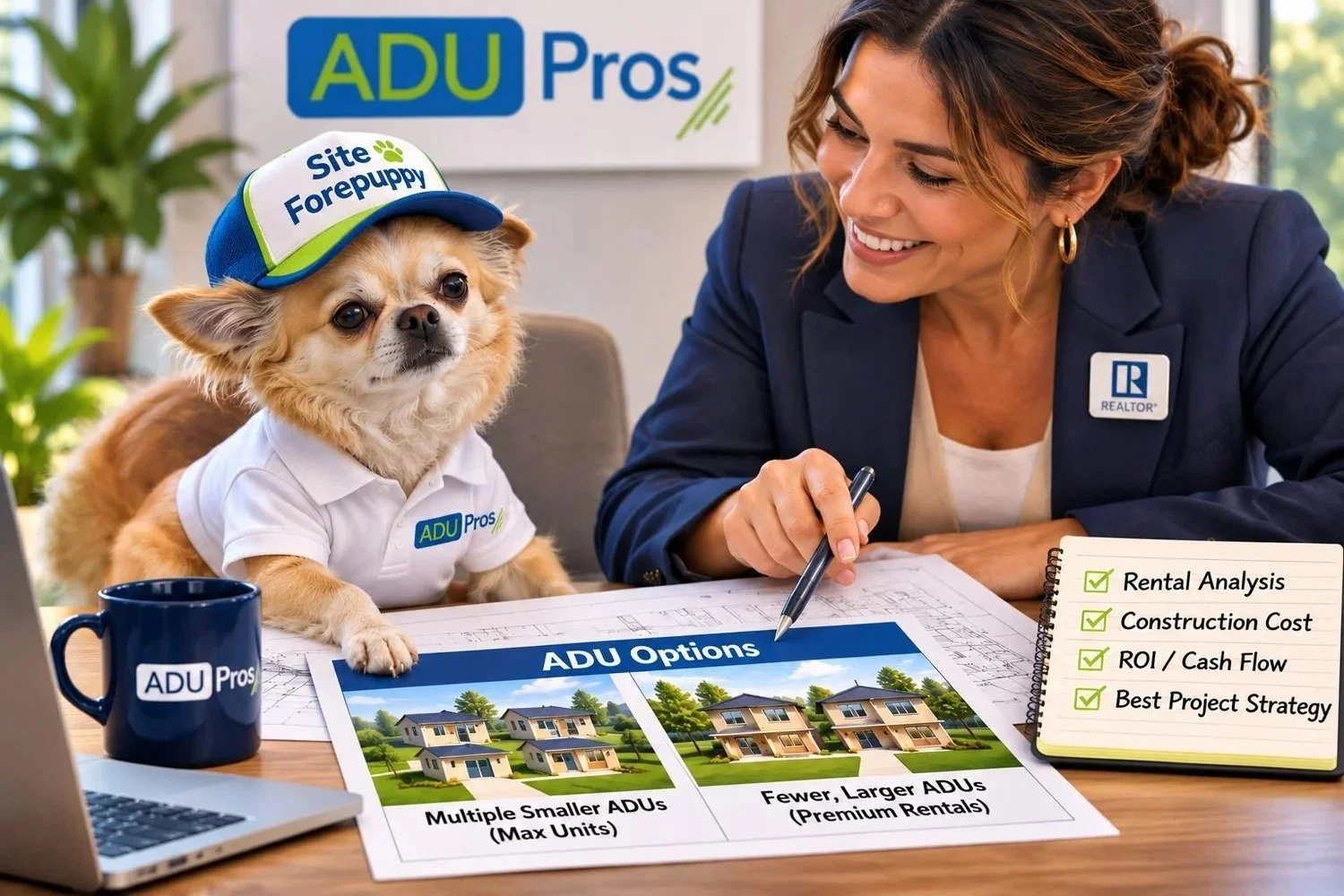
The most profitable ADU project isn't necessarily the one with the most units. And determining the right development strategy should start with your Realtor.
Thinking about an ADU? Tell us about your project and we’ll contact you →
California's expanding ADU laws have created tremendous opportunities for homeowners and real estate investors. Depending on the property and local regulations, owners may be able to construct multiple ADUs, dramatically increasing their property's rental potential. But here's an important question that often gets overlooked: Is it better to maximize the number of ADUs on a property, or build fewer, more desirable units that command premium rents?
The answer depends on several factors, but one of the most important is understanding the local rental market. That's why, at ADU Pros, we strongly encourage property owners to work closely with their Realtor before making major ADU design decisions. A knowledgeable Realtor can help determine what tenants in a particular neighborhood are looking for and how much they're willing to pay. Working alongside an experienced ADU builder who understands construction costs, that Realtor can help the property owner identify the development strategy with the greatest financial potential.
Two Different ADU Strategies — Which Makes More Financial Sense?
Strategy 1: Maximize the Number of ADUs
One approach is to take full advantage of California's ADU regulations and build as many rental units as the property legally allows. This might mean constructing multiple smaller ADUs, maximizing the available building area, and creating several separate rental income streams.
The advantages can include more sources of rental income, less dependence on any single tenant, potentially higher total gross rents, and greater utilization of the property's development potential.
However, fitting more units onto a property often involves compromises. More units can mean smaller living spaces, less privacy, limited outdoor areas, reduced parking, and buildings located closer together. These compromises may affect rental rates, tenant demand, turnover, and the overall desirability of the property.
Strategy 2: Build Fewer ADUs That Feel Like Separate Homes
Another strategy is to build one or two larger, thoughtfully designed ADUs that offer something many renters highly value: the feeling of living in their own private home.
Imagine a detached two-bedroom ADU with its own entrance, a fenced yard, a private patio, dedicated parking, and attractive landscaping. Rather than feeling like one unit in a crowded rental development, the property offers a more traditional single-family-home experience.
Depending on the neighborhood, these features may attract tenants willing to pay a premium for privacy, comfort, and outdoor space. Potential advantages include higher rents per square foot, stronger appeal to tenants seeking a single-family-home lifestyle, potentially longer tenancies, lower turnover, and fewer kitchens, bathrooms, and utility systems to construct and maintain.
The critical question is whether the rental premium for these more desirable units is enough to offset the income that could be generated by building additional ADUs. And that's where the Realtor becomes so important.
Your Realtor Knows the Rental Market. Your Builder Knows the Construction Costs.
Before committing to an ADU design, property owners should consider bringing together two professionals with complementary expertise.
The Realtor: Understanding Rental Income Potential
An experienced local Realtor can analyze comparable rental properties to determine what tenants are willing to pay for different types of ADUs. For example, how much additional rent could a private yard, dedicated parking, or greater separation from neighboring units command? Are two-bedroom detached homes more desirable than smaller one-bedroom apartments? Would two larger ADUs attract longer-term tenants than four smaller units?
A Realtor can also help identify which unit sizes and bedroom configurations are most desirable, estimate achievable rents for each development option, and offer insight into how different configurations may affect future resale value.
A Realtor's understanding of local rental demand is invaluable because the highest theoretical rental income means little if the market won't support the projected rents.
The ADU Builder: Understanding Development Costs
While the Realtor evaluates potential rental income, the ADU builder evaluates the other side of the equation: what it will cost to create that income.
An experienced ADU builder can assess how many ADUs can legally and physically be constructed, determine feasible sizes and layouts, and estimate construction costs for different configurations. This includes evaluating the cost of additional kitchens, bathrooms, utility connections, site improvements, and other factors that can make a higher-density project substantially more expensive.
The builder can also evaluate whether private yards, parking, and greater building separation can be incorporated into the design without sacrificing too much rentable space.
When the Realtor's rental analysis is combined with the builder's cost analysis, the property owner can make a far more informed investment decision.
An Example: Four Smaller ADUs vs. Two Premium Detached Homes
Consider a hypothetical property where local regulations and site conditions permit either four smaller ADUs or two larger detached ADUs.
Four Smaller ADUs
Number of units: 4
Size per unit: 500 sq. ft.
Total living area: 2,000 sq. ft.
Monthly rent per unit: $1,900
Total monthly rent: $7,600
Rent per sq. ft. per month: $3.80
Annual gross rent: $91,200
Two Detached ADUs
Number of units: 2
Size per unit: 800 sq. ft.
Total living area: 1,600 sq. ft.
Monthly rent per unit: $3,400
Total monthly rent: $6,800
Rent per sq. ft. per month: $4.25
Annual gross rent: $81,600
These are hypothetical figures for illustration, not actual rental projections.
In this example, the four smaller ADUs generate $9,600 more in annual gross rental income. But notice that the two detached ADUs command a higher rental rate per square foot.
Now consider construction costs. What if building four smaller units costs substantially more than building two larger ones because of the additional kitchens, bathrooms, utility connections, and other construction expenses? What if the two detached homes experience lower turnover, require less maintenance, and attract tenants willing to pay more for privacy and outdoor space?
The two-unit development might ultimately produce a better return on investment despite generating less gross rental income. Of course, the opposite could also be true. In some neighborhoods, maximizing unit count may be the clear financial winner.
The point is that you shouldn't guess. You should analyze the options before you build.
Why Realtors Should Be Involved Before the ADU Plans Are Drawn
Too often, property owners begin an ADU project by asking a designer or builder one question: "How many ADUs can I fit on my property?" That's an important question, but it shouldn't be the only one. An equally important question is: "What type of rental property will generate the best return in this particular neighborhood?"
That question is best answered with the help of a knowledgeable local Realtor. A Realtor who understands neighborhood rental rates, tenant preferences, and property values can provide insights that significantly influence the design of an ADU project.
For example, a rental analysis might reveal that two-bedroom detached ADUs with private yards are in particularly high demand, that tenants will pay a substantial premium for dedicated parking, or that smaller one-bedroom units command excellent rents per square foot but experience higher turnover. It might also reveal that the additional rental income from a third or fourth ADU would not justify the added construction expense.
These findings can change the entire development strategy. And it's far better to discover them before spending thousands of dollars on architectural drawings and engineering.
ADU Pros: Working With Realtors to Help Clients Make Smarter Investment Decisions
At ADU Pros, we recognize that a successful ADU project involves more than understanding building codes and construction techniques. It also requires a clear understanding of the property's investment potential. That's why we believe Realtors should play an important role in the ADU planning process.
Our approach is simple: The Realtor evaluates the rental market. ADU Pros evaluates the development possibilities and associated costs. Together, we help the property owner compare the options.
We can work with Realtors and their clients to explore different ADU configurations, assess site feasibility, and develop construction-cost estimates that can be compared with realistic rental projections. Whether the best solution is maximizing the number of permitted ADUs or creating one or two premium detached residences with private yards and parking, the objective is the same: Help the client make an informed investment decision based on both potential income and development costs.
Realtors: Your Expertise Can Make the Difference
If you have clients considering an ADU project, encourage them to get a rental analysis before deciding what to build. Your knowledge of the local market may help them avoid an expensive design mistake—or identify an opportunity they hadn't considered.
At ADU Pros, we'd welcome the opportunity to work alongside you and your clients to evaluate their property's development potential. Let's combine your rental market expertise with our ADU design and construction knowledge to help your clients make better investment decisions.
Let's Work Together
Have a client considering an ADU project? Contact us to discuss the property and explore the development possibilities.
Jonathan Webster, ADU Pros Inc. · 619-796-2248 · jonathan@adupros.net